
“Announcing the apocalypse is easy. But doing something constructive with planetary catastrophe is rare and precious.” — Nigel Clark (2011)
t may seem a banal truism to suggest that things are not going very well on this planet for a large number of people. In fact, for many, things have not gone well for quite some time.
While the benefits of “industrial civilization” are numerous, it has also created a myriad of deepening crises and challenges: massive disparities in wealth and health, devastating losses of biodiversity, increasing freshwater scarcity, ongoing diminishment of cultural sovereignty, various forms of environmental toxicity, planetary overshoot, and an escalating climate crisis—all compounded by increasingly out-of-control global infrastructures of surveillance, control, and militarization.
Our news feeds provide a running testimony of just how much is going wrong in so many different places for far too many people.
Scholars, pundits, and scientists from various nations have attempted to characterize these combined and uneven crises with a number of trendy labels: “Globalization,” “Anthropocene,” “Capitalocene,” and others. Yet more and more people are now simply talking about collapse.
“Collapse is a broad term that can cover many kinds of processes. It means different things to different people…” — Joseph Tainter (1988)
What many people seem to be experiencing now is an era dominated by declining political and economic systems that continue to be driven by destructive forms of extraction, industrial production, and capitalist accumulation. As a result, degeneration and nonlinear conflicts are proliferating, initiating a series of phase shifts away from dominant and expansive international industrialized systems toward modes of life increasingly defined by the dissolution, fragmentation, and contraction of those systems and subsystems.
For the last two decades, I have been researching these complex and unequally distributed processes, trying to understand their root causes and wide-ranging effects, and how such “wicked problems” interrelate as symptoms of a faltering globalized civilization.
In his work on the adaptive cycles of living systems, celebrated ecologist C.S Holling described such shifts as a process of moving from a “front loop” phase of growth and accumulation to a “back loop” phase of disorganization and dissipation.[1] Holling and his colleagues demonstrated how these front-loop and back-loop processes themselves consist of four more specific sub-phases that all complex adaptive systems move through: exploitation, conservation, release, and reorganization.
Here is Holling and his colleagues’ original diagram of the adaptive cycle (with indicators for front and back loop added):

In this model, the front loop comprises the first two phases, where initial “exploitation” and early rapid growth lead to the “conservation” and persistence or stability of a system. Such stable states, Holling argued, are never permanent. Gradual or sharp disturbances caused by internal or external forces—or a combination of these—eventually cause systems to shift into a back-loop, marked by a “release” of energies and elements previously captured in front-loop growth and conservation phases. This release and distribution of elements often involves the fragmenting and dispersal of the system’s components and a dissipation of its core energies. This back-loop release phase can (though not necessarily will) then lead a system into a “reorganization” phase, either through an adaptive adjustment and reestablishment of core system functions in a new way, or through a radical transformation and novel recombination resulting in a relatively new system.
Through years of research on various kinds of complex adaptive systems in multiple contexts, Holling found this pattern of adaptive cycling occurring throughout nature at multiple scales—in forests, swamps, deserts, animal populations, plant successions, and even in cities, capitalist markets, and nation-states. This adaptation process of growth, conservation, decline, and reorganization appears to be ubiquitous among the vast majority of interlocking dynamical systems.
The following diagram illustrates the intrinsic dynamism of the adaptive cycling process:
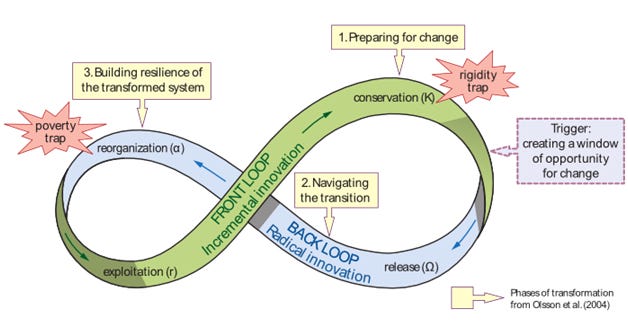
So what are we to do with this? What, exactly, is the back loop in practical terms, and how does this pertain to people’s daily lives?
Without a doubt, living in a time of back loops can be frightening and often quite disorienting. When the systems and institutions people rely on no longer function, and our ability to comfortably provide for ourselves and our families diminishes, people’s lives become precarious as vulnerabilities increase. This can be a time of much uncertainty and unease.
Yet life in the back loop can also be understood as a time of great potential for change and reconfiguration.[2] The release of control and dependence on lifeways and social habits that no longer work—and are often maladaptive—can afford opportunities for alternative adaptations and possible exits from previously rigid and nonviable patterns. Wild experimentation can then become the modus operandi, with unexpected combinations emerging. In such conditions, individuals and groups, as well as ideologies and technics, begin to experiment through novel interactions and cross-pollinations across previously unbridgeable divides. In doing so, they can create and establish experimental, hybrid, or fundamentally new patterns of inhabiting the planet. And despite the fear and reactionary impulses, such novelties might begin generating increased agency that enables resurgences of previously suppressed or excluded ways of adaptive living.
“The back loop is the time of the ‘Long Now,’ when each of us must become aware that he or she is a participant.” — C.S Holling
In her book Anthropocene Back Loop (2020), Stephanie Wakefield details a number of ways people from all walks of life are already embracing and adapting to local collapses of previously dominant modes and are now radically experimenting with different modes of being in the world. Wakefield’s research suggests that many resilient people and communities are beginning to let go of previously established norms, frameworks, habits, technologies, and modes of subsistence to now “hubristically” experiment with alternative pathways for adaptation and thriving.
This moves us toward an awareness of the inherent potential of adopting an experimental approach to living—what I like to playfully refer to as X-life. Such experimental living intentionally attempts to adapt to the conditions and dynamics of a crisis-ridden and multi-back-loop social-ecological world. Given the predominant unraveling characteristic of life in the back loop, the exploration of novel ways of feeding and housing ourselves and maintaining family and community—collectively understood as life-making—will also entail weaving new alliances and collectivities that support people’s efforts to co-cultivate allowances for unknown futures.
Indeed, as Wakefield argues, what is needed in this time of crises and degeneration are a multitude of experimental and alternative autonomous modes of living:
“If we accept being in a back loop, the question becomes, how do we respond? Do we try desperately to maintain the old “safe operating space,” freeze a process already in motion? Or could we let go, allow a time of exploration and experimentation, see what becomes of the pieces of us and the world?”
In my work and life I seek to explore the implications and outcomes of answering Wakefield’s questions in the affirmative. I believe it is imperative to start collaborating on and applying the multiple insights gleaned from a multitude of case studies that feature different people and lifeways as entangled and integral components of various interacting complex adaptive systems, and then to apply such lessons of how to live and thrive among the multiple ecological, political, and cultural crises of our time.
☆
REFERENCES:
[1] Lance H. Gunderson and C.S. Holling (ed), Panarchy: Understanding transformations in human and natural systems (2002).
[2] Shana M. Sundstrom and Craig R. Allen, “The adaptive cycle: More than a metaphor” (2019)
[3] Stephanie Wakefield, Anthropocene Back Loop: Experimentation in Unsafe Operating Space (2020)
 ENTANGLED ECOLOGIES
Leave a comment