
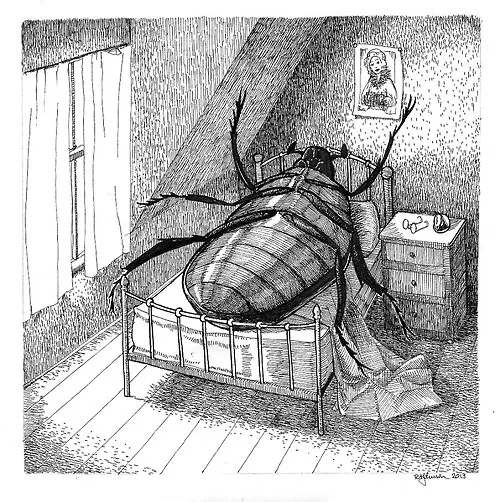
In Franz Kafka’s novella “The Metamorphosis” (1915), transformation becomes a multi-layered and complex symbol. It is far more than just a bizarre physical change; it serves as a catalyst that exposes the true nature of human relationships, identity, and societal values.
Contemporary master composer Phillip Glass wrote the music for a live staging of Franz Kafka’s Metamorphosis in 1988.
One of the most compelling interpretations of the story is that Gregor’s metamorphosis is not a sudden misfortune, but rather a physical manifestation of an identity that had long been suppressed. Before his change, Gregor was trapped in a dehumanizing job he despised, solely to pay off his family’s debts. His existence was defined by his utility as a traveling salesman. In this reading, his insect form represents his true, hidden self—a self that is “grotesque” and unacceptable to a world that only values productivity .
The transformation forces this authentic identity to the surface, making it impossible for him to continue his role as the family’s provider. The story’s famous opening line immediately establishes this irreversible shift:
“When Gregor Samsa woke up one morning from unsettling dreams, he found himself changed in his bed into a monstrous insect…”
His new form becomes a barrier to his previous life, and his desperate attempts to cling to his old duties highlight the conflict between his imposed role and his new reality. His family’s horror and rejection stem from their inability to accept this version of him, which no longer serves their needs.
Kafka powerfully illustrates how alienation and dehumanization can strip an individual of their identity and connections. Gregor’s physical transformation leads directly to his psychological and social isolation. As he becomes a burden rather than a breadwinner, his family’s tolerance erodes into open hostility. He is no longer seen as their son and brother, but as a repulsive creature. Gregor himself poignantly expresses this deep sense of isolation:
“I cannot make you understand. I cannot make anyone understand what is happening inside me. I cannot even explain it to myself.”
In the story the concept of metamorphosis extends beyond Gregor himself. His change triggers a transformation in his entire family and exposes the corrosive nature of a system built on obligation . While Gregor physically deteriorates, his father, mother, and sister undergo their own changes. The father, once tired and dependent, finds new (if grim) energy by returning to work. Grete, who begins as a compassionate girl, matures but also hardens, ultimately becoming the one who advocates for Gregor’s removal. This shift illustrates how the family, once supported by Gregor, adapts and reconfigures itself by casting him out.
Ultimately, the mystery of Gregor’s transformation came down to a question of continuity in his affective capacity to feel and think as humans do:
“Was he an animal if music could captivate him so? It seemed to him that he was being shown the way to the unknown nourishment he had been yearning for.”
― Franz Kafka, “The Metamorphosis”
This highlights the central tragedy of the story: Gregor is still human inside, but his exterior has made him an outcast. Ultimately, the novella suggests that transformation is an inevitable process, but it is the reactions to it—both personal and societal—that determine whether it leads to growth or to destruction.
○●◉○●
In the final decades of the nineteenth century, famed philosopher Friedrich Nietzsche composed a series of works that did not simply interpret the spiritual atmosphere of Europe but unsettled it from within. Among them, Thus Spoke Zarathustra unfolds as a movement of descent: a solitary figure returns from years of mountain seclusion carrying not doctrine, but a sharpened clarity shaped by distance, silence, and exposure. What he brings back is less an answer than a change in altitude – a metamorphosis in how the world itself can be sensed. What remains is an opening—strange, unbounded, and difficult to inhabit. Familiar coordinates loosen. Certainty gives way to atmosphere. The ground does not disappear, but it begins to feel subtly in motion, as though reality were reorganizing itself beneath perception.
Early in Zarathustra, this movement converges into the image of three metamorphoses. “Of three metamorphoses of the spirit I tell you,” Zarathustra says, “how the spirit becomes a camel; and the camel, a lion; and the lion, finally, a child.” The sequence does not describe a simple progression upward. It moves instead through shifting textures of experience—weight, rupture, and emergence—each with its own gravity and necessity.
The camel is the being that carries. It kneels to receive burden: obligation, endurance, truthfulness, the long inheritance of what has been handed down. Laden with necessity, it enters the desert, a landscape stripped of distraction where distance stretches in every direction. Here transformation begins quietly. Nothing dramatic occurs, yet everything changes through exposure to vastness, heat, and solitude. The spirit learns the density of what it bears.
In the loneliest reaches of this desert, a second change takes shape. Endurance hardens into force; the camel becomes a lion. The lion turns toward what commands and confronts it directly. Before it stands the radiant dragon of injunction, every scale inscribed with authority. Against this shimmering weight, the lion speaks a different word: I will. The sound is abrupt, almost improbable, like thunder in clear air. Space opens where none seemed possible. Yet this freedom is edged and incomplete, defined by the very power it resists.
Beyond struggle, another transformation waits—quieter, more disorienting. The lion yields to the child. Not regression, but beginning. The child moves without the heaviness of burden or the tension of defiance. Forgetting becomes fertile ground. Play becomes a mode of knowing. Motion arises from within rather than in reaction to what stands outside. Creation appears here not as grand construction but as a subtle turning of the world toward new patterns of sense and relation.
To revisit these metamorphoses now is to notice how closely they resemble the textures of change unfolding around and within us. Transformation rarely arrives as spectacle. More often it proceeds through slow distortions of the familiar: seasons that no longer keep rhythm, institutions that persist yet feel hollowed, identities that loosen before new forms are visible. The ordinary begins to shimmer with faint discontinuities. Something is ending, though it continues to function. Something else is beginning, though it has not yet taken shape.
In such conditions, metamorphosis is less a metaphor than a description of atmosphere. We find ourselves carrying more than we understand, resisting forces we cannot fully name, and sensing the approach of beginnings that do not resemble the past. The process is uneven, at times disquieting, yet threaded with unexpected openings—moments when perception clears and the possible briefly widens.
The figures of camel, lion, and child return here as companions for moving within this shifting terrain. They do not prescribe a path. They illuminate phases of becoming that overlap, recur, and fold into one another. Each names a different way the spirit learns to live inside change: by bearing, by breaking, by beginning.
○●◉○●
The word metamorphosis derives from Ancient Greek μεταμόρφωσις, “transformation, transforming”, from μετα– (meta-), “after” and μορφή (morphe), “form”.
Science describes metamorphosis is the biological process by which an animal physically develops including birth transformation or hatching, involving a conspicuous and relatively abrupt change in the animal’s body structure through cell growth and differentiation.
However, metamorphosis is often considered generally as a more comprehensive process of an individual organism’s development from the fertilized egg to its mature, adult form, and encompassing its entire lifespan. In less words, it’s about the transformation of form and capacity over time.
Everything that exists came to be through a process of systemic development in our evolving universe. Development of a system toward some specific end, absent regulation, invariably leads to the system’s senescence, a precarious developmental end-stage in which the system, having developed to the limit of its capacity for that specific trajectory of development, is no longer able to adapt to disruptive change and is thus poised for collapse. As a result of unregulated development, our global civilization has entered senescence and has begun collapsing. Collapse of a senescing system can either be terminal — as in death or extinction — or transitional, heralding the birth of a new, incipient (undeveloped or immature) system — i.e., metamorphosis.
From the internal perspective of a mature or senescent system (i.e., the prevailing perspective held by constituents of the system), metamorphosis is inherently unpredictable (given that there is no precedent encoded in the system’s models), and in many ways indistinguishable from destruction, so at best we in the civilized world can only hope that collapse of our civilization will lead to its metamorphosis and not a complete obliteration of humanity. Despite this unpredictability, we can examine known examples in a variety of systems to gain insight into what metamorphosis generally entails and ask how often it occurs in the natural world. – James A. Coffman
 ENTANGLED ECOLOGIES
Leave a comment