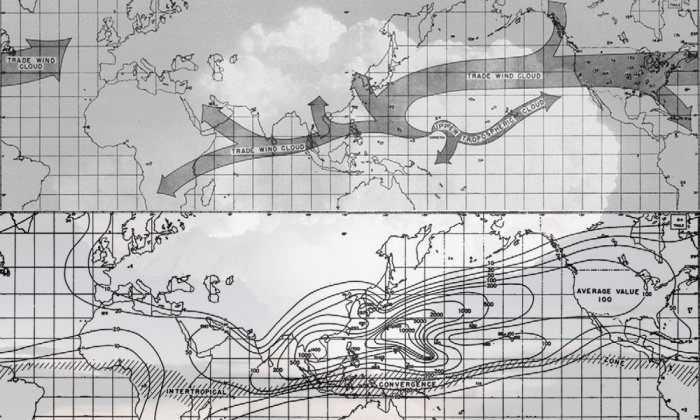
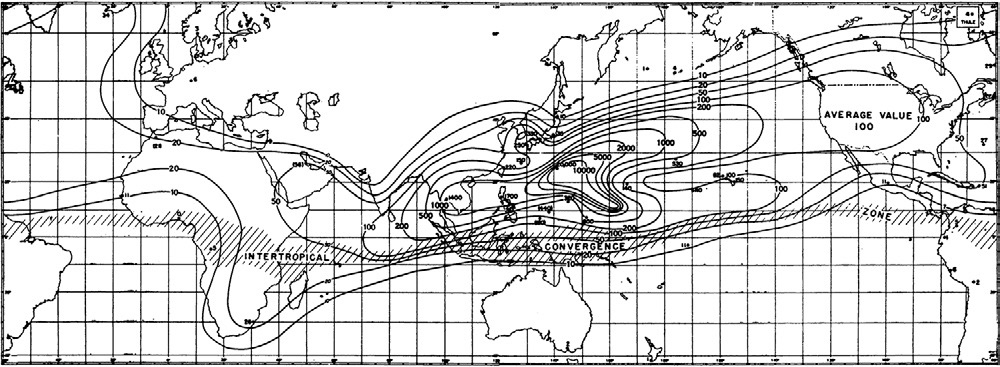
In 1956, three meteorologists from the U.S. Weather Bureau—Lester Machta, Robert J. List, and Konrad Telegadas—published a pair of maps (below) in the influential journal Science. Those maps would go on to become icons in the history of both the Earth sciences and the modern environmental movement.
The maps were initially part of an effort to provide the first publicly accessible information about the environmental consequences of U.S. nuclear testing. They presented the key scientific findings from the Castle series of atmospheric nuclear tests, conducted by the Atomic Energy Commission (AEC) in the Pacific Proving Grounds (notably Bikini and Enewetak atolls) in 1954. Beyond their immediate subject, the maps demonstrated the power of a new global atomic fallout monitoring network established by the United States and its allies in the late 1940s. That network, which tracked radioactive debris across continents and oceans, was the direct precursor to later innovations in Earth systems science and environmental monitoring that would mature in the following decades.
This geophysical knowledge became the foundation of what we now recognize as planetary atmospheric and oceanic circulation models. By tracking the diffusion of radionuclides—both through the atmosphere and through plants, animals, and human populations—scientists were able to empirically demonstrate the deep integration and interconnectedness of the entire biosphere.
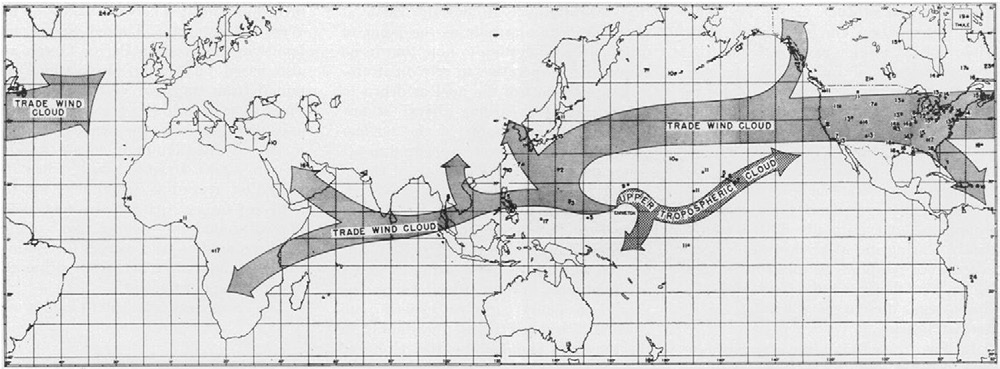
Map of isolines showing the overall dispersion of radioactive particles and their concentration
Perhaps even more significantly, the maps diagrammed, for the first time, the global atmospheric movements of radioactive fallout in a way that was immediately comprehensible to lay audiences. Using clean isolines to represent cumulative deposition (e.g., of strontium-90 and cesium-137), they translated complex atmospheric transport processes into a striking visual narrative.
As the maps circulated through the popular press and mass-circulation publications, they visually demonstrated—in an easily accessible form—the links between large‑scale planetary systems and human actions. This imagery rapidly expanded public understanding of the biosphere as a radically interconnected ecological space, where a nuclear detonation in the remote Pacific could deposit radioactive material on farms in Europe and North America within weeks.
The renowned environmentalist Rachel Carson, unsurprisingly, drew directly on these studies. In her landmark 1962 book Silent Spring, she cited the fallout research to denounce the global circulation and accumulation of chemical pollutants—particularly the pesticide DDT—throughout the biosphere. Her work, in turn, heavily influenced an emergent worldwide environmental movement.
The unintended consequence of this new ecological imaginary was that it profoundly contributed to a growing cultural and political concern over the negative effects of industrial technology on planetary ecosystems. What began as a military‑scientific effort to understand fallout awakened public awareness of global environmental vulnerability.
Today, knowledge of negative planetary‑scale trends—such as climate heating and the long‑range transport of anthropogenic pollutants—has become common. Most educated people can describe in broad strokes how microplastics, per- and polyfluoroalkyl substances (PFAS, or “forever chemicals”), and other toxins move from region to region: dispersed in the upper atmosphere, transported to the ocean depths, or bioaccumulated within our own bodies.
Despite the ongoing threats brought to light by major sciences and rapidly advancing technology, it was the efforts of these early researchers and science communicators—seeking to engage the public on planetary‑scale threats—that sowed the seeds for what may one day become genuine planetary thinking.
◉●○•°


Leave a comment