How one village built a rainwater revolution
Water is woven into the fabric of human life, yet modern society rarely acknowledges just how central it is—the basis of every world in which we can thrive. This mismatch between water’s importance and our thin ecological literacy, especially across the Global North, shows up most starkly in the failure of governments to solve local water crises that only keep escalating.
As Felipe Rossi writes,
“We have been taught that water problems require engineering solutions. Dams, pipelines, desalination plants, pumping stations. Infrastructure that costs billions and takes decades to build. Infrastructure that requires experts and permits and environmental impact assessments.”
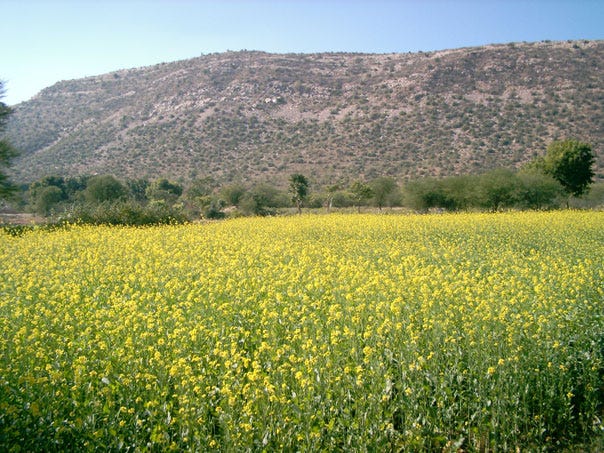
But in Rajasthan, India, a child’s birth is celebrated by walking around the village well, and a person’s final rites involve a journey to holy water. For centuries, this arid land—receiving a scant 16 inches of rain a year—thrived thanks to an ingenious ancient technology: the johad.
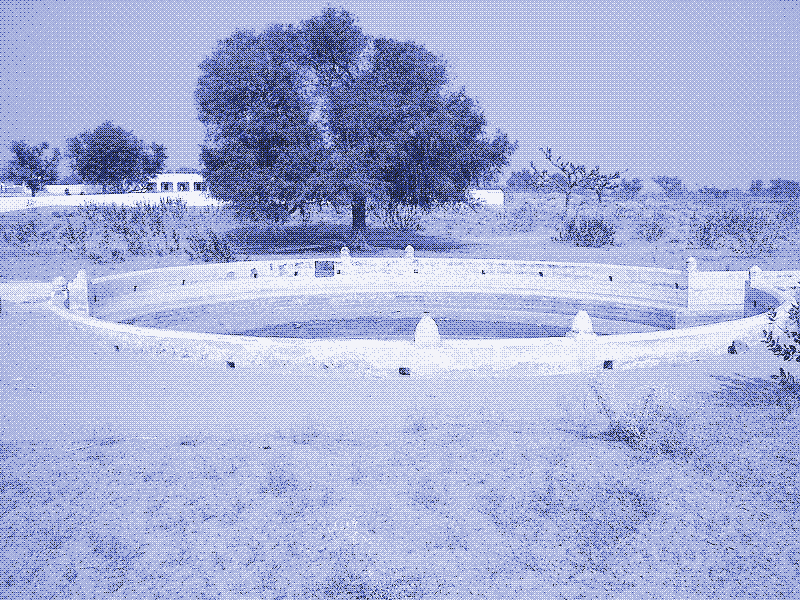
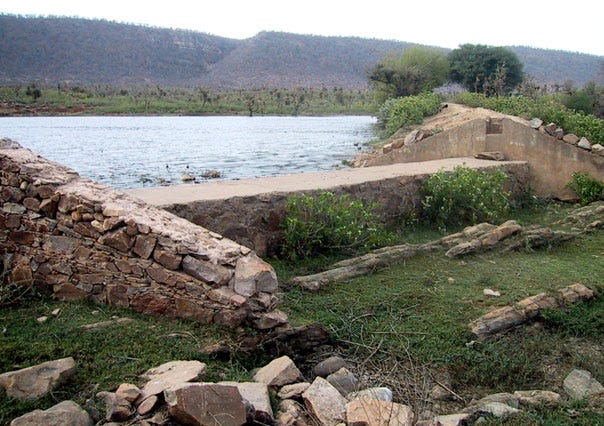
These humble, crescent-shaped dams of earth and rock did more than hold monsoon rainwater for livestock. Their true genius was invisible. By holding water in place, they let it slowly percolate into the earth, recharging the underground aquifer for up to a kilometer around. It was a self-sustaining system, built and maintained by the community, that kept wells full and fields green through the long dry season.
By the 1980s, though, this ancient wisdom had been all but forgotten, and the region had become an ecological and social disaster zone.
A Downward Spiral
The story of how this happened is an increasingly familiar one: a vicious cycle set in motion by a single broken link. It began when the forests protecting the region were cleared for timber. Without trees to hold the soil, monsoon rains washed precious topsoil down the hillsides, silting up the johads. Without silt-free basins to maintain, community upkeep lapsed, and the structures decayed further. Into the gap stepped the government, with a modern fix: “tube wells,” deep bores fitted with diesel pumps.
At first, they seemed miraculous. But they pulled water out of the ground far faster than the dying johads could put it back. As the water table dropped, farmers drilled deeper wells, which only pulled the water table down further still. One villager remembered it plainly: “They took so much water… that eventually it became impossible to get water more than five or six hours a day.”
The consequences cascaded. Wells ran dry. Rivers stopped flowing. Trees, no longer able to reach the water table, died where they stood. With less vegetation to seed the atmosphere, the monsoon itself grew shorter and more erratic. The social fabric frayed along with the land: unable to farm, young men migrated to city slums in search of work, while women and children walked up to ten hours a day just to fetch water and firewood. There was no time left for school, for other work, or for the collective labor that might have rebuilt the very structures that could have saved them. The johads faded into memory—footnotes in a landscape that had forgotten how to hold onto rain.
A Doctor with a Shovel
This was the desolate landscape a young doctor named Rajendra Singh stepped into in 1985. Trained in Ayurvedic medicine, Singh had come to Rajasthan with the Tarun Bharat Sangh (TBS), a small volunteer organization, hoping to open a rural health clinic.
But the villagers of Gopalpura, led by an elder named Mangu Lal Meena, told him something he hadn’t expected: forget medicine—the immediate need was water. If he wanted to help, that’s where he had to start.
Meena remembered the johads of his youth. On his advice, Singh and two colleagues picked up shovels and began digging the silt out of a long-abandoned pond. They worked largely alone for months, until Meena began paying helpers in grain. In a time of scarcity, food proved a far more persuasive currency than promises.
After roughly seven months of labor, they had excavated a johad some 15 feet deep. Then the monsoon arrived—the strongest the region had seen in four years. The pond filled. And then came the moment that would change the trajectory of an entire region: a nearby well, dry for years, began to flow again.
A Cascade of Good Fortune
That single revived well was the ecological tipping point. It didn’t just bring back water; it brought back hope, and set off a cascade of changes that fed on each other.
Word of Gopalpura’s success spread to neighboring villages. With technical guidance from TBS, communities poured thousands of person-days of labor into rebuilding their own johads. The effects were dramatic and self-reinforcing:
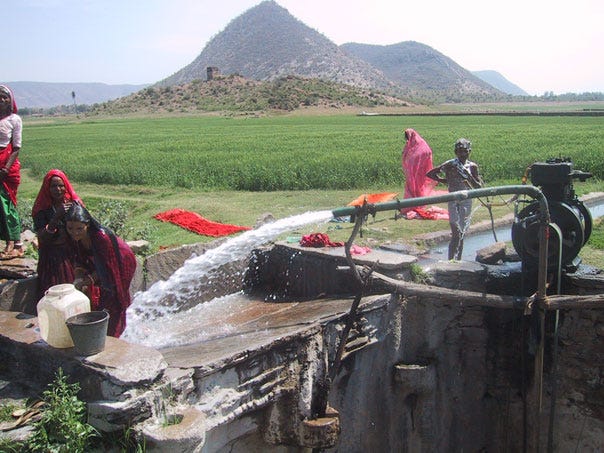
Water returns. By 1996, Gopalpura alone had built nine johads. The water table, which had sunk to 45 feet, rose back up to just 22 feet. Every well in the village ran full again.
The economy revives. With water closer to the surface, the diesel cost of pumping it dropped by roughly 75 percent. Irrigated farmland expanded, and farmers began growing higher-value crops like sugarcane and potatoes.
Forests and wildlife rebound. As the aquifer refilled, the land greened again. Trees that had appeared dead sprouted new leaves. Birds and animals returned to a landscape they had abandoned.
A river is reborn. The most striking success was the Arvari River, a dry sandbed for decades. After years of johad-building across its roughly 400-square-mile catchment, the Arvari began to flow again—perennially, for the first time in living memory.
Community is restored. With water and food secure, migration slowed and reversed. Children returned to school. Women reclaimed hours of their day. Village councils, or gram sabhas, came back to life to manage water collectively—eventually forming what locals call the Arvari “river parliament,” a self-governing body of villagers that regulates fishing, farming, and water use along the river to this day.
The man behind that first shovel, Rajendra Singh, became known across India as the “Waterman of India.” Working with TBS, he and thousands of villagers went on to build close to 9,000 johads and related structures, bringing water back to more than a thousand villages and reviving not just the Arvari but at least six other rivers—among them the Ruparel, Sarsa, Bhagani, and Jahajwali. The Alwar district, once officially classified a “dark zone” for its vanishing groundwater, was reclassified a “white zone.” In 2001, Singh won the Ramon Magsaysay Award for community leadership; in 2015, he received the Stockholm Water Prize, sometimes called the Nobel Prize for water, in recognition of a movement that began with two colleagues, an elder’s advice, and a shovel.
What started in one village has since spread across Rajasthan and beyond. The story of the johads is a powerful testament to a simple, radical idea: that solutions to our biggest problems often lie not in expensive, high-tech fixes, but in reviving ancient wisdom and trusting the power of community.
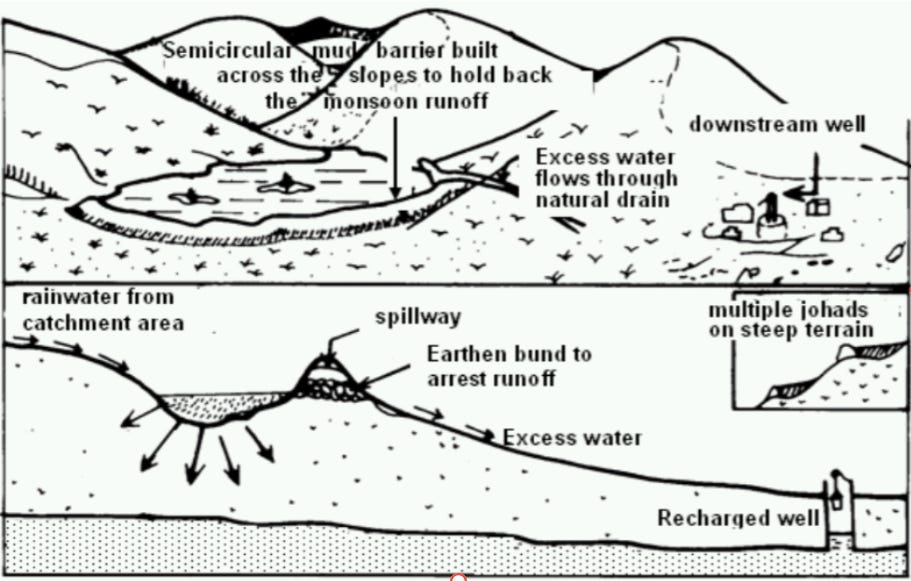
These traditional water-harvesting structures are remarkably simple and cheap to build, relying not on heavy machinery or costly materials but on collective labor and whatever earth and stone lie close at hand. The process starts with digging a basin; the excavated earth is then packed into a crescent-shaped embankment across a natural slope. A stone outlet is sometimes added to manage overflow, letting excess water either soak into the ground nearby or feed into the next johad down the line. Their primary job is to catch monsoon runoff and let it filter slowly into the water table over the dry months that follow. Multiply that effect across hundreds of structures spread over a watershed, and the result can be the restoration of an entire regional aquifer.
Felipe Rossi again:
“We do not need to wait for governments or engineers or billion-dollar budgets. A community with shovels can change its watershed. A neighborhood that understands contours can capture rain that currently floods streets and disappears into drains. The most sophisticated water infrastructure might be the kind that requires no sophistication at all.”
By restoring the land’s ability to hold onto water, the villagers of Rajasthan didn’t just fight a drought—they reversed one. They proved that when you hand a community a tool and trust them to use it, you don’t just replenish groundwater. You replenish life itself.
You can read the full, in-depth story and explore the specific “ingredients for success” that made this project work on The EcoTipping Points Project website: Water Warriors: Rainwater Harvesting to Replenish Underground Water (Rajasthan, India). The site also features an 11-minute video, a photo gallery, and educational materials.


Leave a Reply