The field is not out in front of us. It is underfoot.
1.
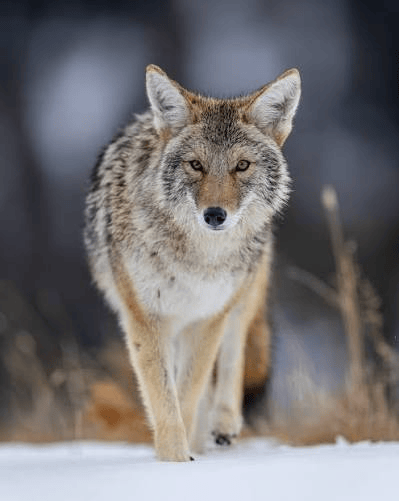
For most of the twentieth century the coyote was supposed to be on its way out. Governments paid bounties for its pelt, ranchers laced carcasses with strychnine, and federal trappers killed it by the hundreds of thousands. A creature of the open prairie, it should have shrunk back into whatever shortgrass was left. Instead it walked east and north and into the cities. It reached the Atlantic, crossed into Central America, and learned to den under porches in Chicago and to cross six lanes of traffic in Los Angeles on the green light. Nobody planned that future for the coyote, least of all the people paying for its ears. Yet the city was already full of what a coyote could use: rail corridors and storm culverts, rats and windfall apples, parks that empty at night. The coyote did not discover a new future. It discovered what was already lying around, waiting for an animal with the nerve to use it.
I keep returning to the coyote because it embarrasses the way we usually talk about the future. In “Global Weirding and Deep Adaptation” (2018), I toyed with the idea that the spectrum of options for envisioning the future is wider than what can be gleaned from two of the more popular tropes cluster, which can be loosely referred to as the “techno-utopian” and “neo-primitivist” futures. There I argued for fleshing out different strains of pragmatic thought that might attempt to salvage elements from the past while drawing from present to construct novel, context-dependent, negotiated hybrid futures.
In a post for The Learning Planet, Bridget McKenzie offers a complementary narrative for would-be futurists through what she calls ‘possitopian’, an approach that refuses to privilege either utopian or dystopian imaginaries. Instead, McKenzie urges people to remain open to the myriad of possibilities in which both positive and negative aspects mingle and outcomes combine and coexist to shape unknown but adjacent futures:
“Being Possitopian means both facing the worst and imagining the best, in ways that are both much more rational and critical, and much more creative and open-minded. And also, it means anticipating the future much more frequently, in many more situations and permutations, involving a greater diversity of people. Managing the risks of the planetary emergency is not about working out the best response to the most likely outcome, it is about determining the best response to the full distribution of possible outcomes.”
I think Bridget hits on a crucial insight: the benefits of cultivating the capacity to remain open and agile in both our thinking and attitudes as meta-adaptive strategy. Possitopian orientations might be essential for those of us seeking to adapt to increasingly challenging circumstance by helping us develop more flexible dispositions, toolkits, and imaginaries capable of escaping capture by any particular ideological or theological vision of what the future holds.
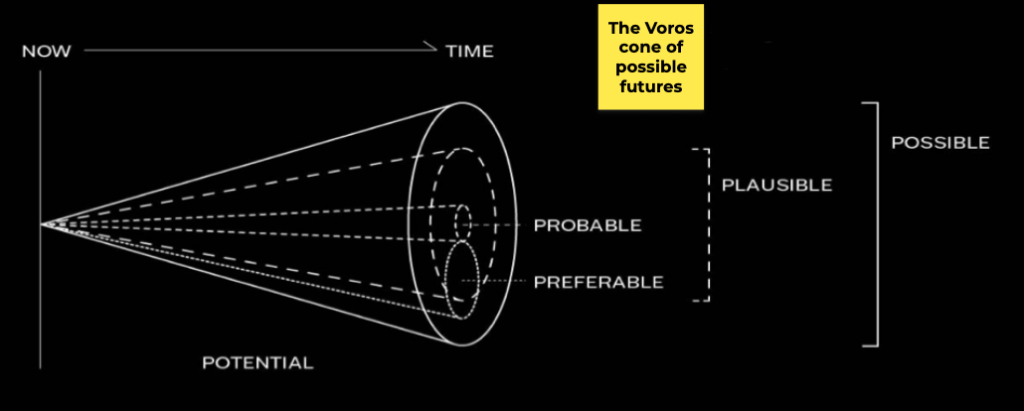
And yet the coyote suggests that even this generous picture keeps the possible in the wrong place. Futurists like to draw a cone that widens out from the present, with the probable at its center and the merely possible at its flaring rim, and the task is always to see further into the cone. McKenzie widens it; she does not leave it. But the coyote’s future was never out there in the cone. It was here, in the culverts and the rats and the animal’s own appetites, long before anyone noticed. What if the possible is not ahead of us at all, but folded into everything that already exists?
2.
The Romans set Janus over their doorways. He had one head and two faces, one looking back into the house and one looking out onto the street, and he presided over every beginning because every beginning is also a threshold. I can think of no better emblem for the relation between what is and what could be. The actual is the Janus face of the possible. Look at any arrangement of the world from one side and you see something settled: this much water, these fences, these streets, these animals. Look at it from the other side and you see everything that arrangement could still become. It is the same head.
The idea is older than it sounds. Aristotle had to defend it against philosophers who insisted that a thing can do only what it is doing at this moment, so that a builder who is not building is no builder at all. Absurd, he replied: on that view no one could ever begin to build, since before building no one would be able to. The builder resting at noon is still a builder; what he can do belongs to him as surely as what he is doing. Twenty-three centuries later Henri Bergson turned the screw. We like to imagine, he wrote, that the possible comes first, a pale outline that reality later fills in. It is the other way around. Once something genuinely new has happened, we cast its image backward and tell ourselves it was possible all along. The possible, in that sense, is the shadow the real throws behind it.
Bergson’s point cuts deep against the habit of futurism. If the future were a menu of possibilities sitting in the cone, waiting to be selected, then nothing truly new could ever arrive; we would only be picking from options already drawn. But the urban coyote was not on anyone’s menu. It was not a picture of the future waiting to be realized. It was something the coyote and the city made together, out of what each happened to be able to do, and only afterward could we say it had been possible.
This is the first provocation I want to explore. The future is not a destination: it is a property of the present, and like every property it is unevenly distributed. A paved lot and a wooded ravine have different futures because they are different presents. To change what can happen, there is no way around changing, or entering into new relations with, what is.
3.
If the possible lives inside the actual, it is not a blank field where anything at all might happen. It has a shape. Water poured on a hillside does not go wherever it likes; it follows the grain of the land, gathers in hollows, and cuts the channels that later water will follow too. Most of what could happen to a place is like this. Some outcomes lie downhill and will happen almost no matter what anyone does. Some sit behind a ridge that only a great push will carry anything over. Some are simply out of reach from where things now stand.
The shape also changes as things happen. The biologist Stuart Kauffman calls the set of next steps open to a living system its ‘adjacent possible’, and his central observation is that taking any one of those steps rearranges the rest. A new molecule makes new reactions available. A new tool makes new tools thinkable. A coyote that learns to eat from dumpsters raises pups that never learn to fear people, and those pups find doors their parents never saw. Every arrival opens rooms that did not exist before it, and closes others that did. The space of what can happen is not a territory waiting to be explored. It is being built as it is explored, by everyone and everything moving through it.
Here the cone collapses. A cone treats the future as a matter of distance, nearer or further from now, likelier or less likely. The coyote’s road into the city shows that what matters is not distance but adjacency: what lies one step away from where things actually are. The century of poison and bounties did not close the coyote’s future; it rearranged what was adjacent, killing off the bold and the settled and favoring the wary, the mobile and the quick to breed. The persecutors made the animal they feared.
For anyone hoping to steer toward a livable future, this is unwelcome news and also good news. Unwelcome, because no amount of imagination will make a future reachable if the present has drifted too far from it; a drained marsh does not become a marsh again because we can picture one. Good, because the way back is not through the crystal ball but through the ground. Rebuild enough of what is actual, and a better future becomes adjacent again.
4.
Wildlife biologists noticed something odd about coyotes under heavy persecution. Kill enough of them, and the survivors breed younger, more of the females breed, and litters grow larger. A population culled hard can rebound to its former size within a year or two. The coyote had, all along, the ability to answer slaughter with fecundity. Nobody saw it until the slaughter called it out.
That is the strange status of what a thing can do. A list of what something is, its size, its weight, its color, can be drawn up at any time. A list of what it can do can never be finished, because abilities show themselves only when something calls them out, and no one knows in advance what will. A knife can cut bread, open a letter or wound; it does none of these alone, and none of them is visible in its length and sharpness. Spinoza put the point with characteristic dryness more than three centuries ago: no one has yet determined what a body can do. He meant human bodies, but the sentence travels. No one has determined what a coyote can do, or a river, or a city block, or a seed bank in a drought.
These hidden abilities are where the two faces of the actual meet. They belong to real things, here and now, so they belong to the face that looks back. They point toward what those things might do, so they belong to the face that looks forward. The coyote’s tolerance for noise and its taste for garbage were real long before there were cities to test them. They waited, unexercised, for the right encounter, and when the encounter came they made a future no one had foreseen.
This is why every inventory of a place undercounts it. Ask what a landscape has, its resources, its assets, its stock, and you will miss most of what it can do, because what it can do appears only when new relations are tried. It is also why the knowledge that matters most is so often held by people who work closest to the ground: the rancher who knows which slough still holds water in a dry year, the elder who knows where the berries move after a fire. They know abilities, not just inventories. They know what the place can become.
5.
A storm culvert under a suburban highway is, to the engineer who specified it, a drainage pipe of a certain diameter. To a coyote it is a safe road under six lanes of traffic. To a raccoon it is a den, to a teenager a place to smoke, to a heavy spring melt a bottleneck. One concrete pipe, a dozen different offers. The psychologist James Gibson spent his career insisting that this is how every creature meets its world: not as a collection of objects with properties, but as a field of offers, of things to eat, to hide under, to climb, to avoid. What a thing offers is neither in the thing nor in the animal alone. It lives in the meeting.
Humans live in a thicker field of offers than any coyote, because so much of what the world offers us depends on what we have learned to do with it. A ballot offers nothing to someone who has never voted; a sailboat offers nothing to someone who cannot sail; a forest offers medicine only to those who know which bark to strip. Whole ways of life are, among other things, ways of being offered a world. When those ways of life are lost, the world does not lose its plants or its rivers. It loses what they offer to anyone.
The ability of a thing to act and the offer a thing makes are two sides of one relation. The culvert’s ability to carry an animal and the coyote’s sense of a safe passage are the same fact seen from either end. And here is what makes the coyote’s story more than a curiosity. Living things do not only take the offers they find; they change what the world offers to everyone who comes after. Every dam, ditch, highway and housing development rearranges the offers of a landscape for thousands of creatures who were never consulted, and the rearrangement outlasts its builders by decades or centuries. The engineer who drew that culvert redrew the coyote’s map of the continent without knowing it.
So the possitopian question “what futures are possible?” turns, on closer inspection, into a sharper one: what does this place offer, to whom, and what will our next move offer or withdraw? A new reservoir offers boating to a city and drowning to a valley’s burial grounds. A wildlife overpass offers a bear a way across and a developer a delay. Every future we build is a redistribution of offers among the living, whether or not we notice we are making it.
6.
A river held behind a dam stops flooding its delta, and the delta stops receiving the silt that built it. The farmers downstream find their fields sinking and salting; the fishers find the fish gone. The dam’s builders wanted power and irrigation, and they got them. The rest arrived through threads no one had traced. No ability and no offer stands alone. Each hangs on others, and pulling one moves things far away, in places and bodies the puller never sees.
It would be easy to conclude that everything is connected to everything, and to leave it there in a warm haze. That conclusion is false and useless. What the dam shows is not that everything is connected but that particular things are bound together in particular ways, by silt and current and rainfall and price, and that those bindings decide which abilities can meet and which offers can appear. A bank channels a river into a current; a grammar channels noise into sentences; a trellis lets a vine climb higher than it could ever stand. Limits, in other words, are not only limits. The right constraint is what makes some futures possible at all. The wrong one, or the right one for somebody else, shuts them.
And so we arrive at politics, which the cone of futures politely leaves out. The future is not open. It is held open, by someone, usually at someone else’s expense. For five centuries the business of the modern economy has been to secure cheap food, cheap energy, cheap labor and cheap raw materials, which in practice has meant remaking whole landscapes so that some people’s futures could widen while others’ narrowed to a point. A mining town becomes a pit. A delta becomes a sacrifice zone. A forest becomes a plantation of one tree. Every frontier opened for profit is a future closed for the people and creatures who lived there, and in the language of the boardroom this is called opportunity.
The coyote’s story looks different in this light. Its triumph in the cities is real, but it rides on a continent emptied of wolves, plowed of its tallgrass, and paved into a field of culverts and dumpsters. The coyote is a creature of the ruins we made, and it has thrived in them because its abilities happened to match the offers our wreckage left behind. Plenty of other creatures were not so lucky. To ask what is possible, honestly, is to ask whose possibilities a given arrangement keeps alive and whose it quietly forecloses. That is not a technical question. It is the oldest political question there is, asked of a new and larger company.
7.
To be sure, as social-ecological systems continue to break down, unevenly distributed disruption and fragmentation will place extraordinary demands on people, demands that will no doubt surprise them with regard to the intensity and multiple scales of the impacts. Adopting a possitopian attitude can help people remain sufficiently open to such surprises, and therefore become more readily capable and willing to scan their immediate horizons for practical opportunities, important interventions, and rapid transitions. This kind of open anticipatory awareness can also prime folks for ideas and strategies that might have seemed strange or inappropriate within previous reinforced frames of reference and evaluation, but may now be adaptive given changed circumstances.
What does it mean, though, to remain open in this way? To tarry with possibility? To tarry is not to flit rapidly among possibilities, nor to suspend judgment indefinitely. Rather, it is to dwell patiently with uncertainty, allowing competing futures to coexist without forcing a premature resolution. The philosopher Slavoj Žižek, in Tarrying with the Negative, argues that tarrying with what seems negative or contradictory can reveal hidden productive forces. A possitopian adaptation of this idea would be tarrying with the possible: holding space for both catastrophic and hopeful scenarios, not as an act of indecision but as a rigorous discipline.
McKenzie pushes further:
“Possitopian thinking maybe offers a field rather than a path. It helps you resist predefined or hackneyed visions. We already know images of dystopia and utopian from movies and advertising… Possitopian approaches don’t try to create a third trope but to overcome fixed, limited and binary ways of thinking. Many people might flip from dystopian to utopian visions – drawing on what culture has offered them – depending on their feelings at any moment. Possitopian practice allows us to imagine new possibilities by talking and weaving together rather than flipping helplessly.”
A field rather than a pathway. I want to take her more literally than she may have intended. The field is not out in front of us. It is underfoot, in the culvert and the slough, the dumpster and the delta, the habits of animals and the skills of neighbors. Tarrying with the possible, on this reading, does not mean gazing harder into the cone of futures. It means staying with a place long enough to learn what it can do: the ground it slopes toward, the abilities it carries unused, the offers it makes and to whom, the threads that bind its fate to places far away. This is slower work than scenario planning and far less glamorous. It happens on foot, in conversation and over seasons. It is also more honest, because it refuses the fantasy that a future can be chosen from outside the world that will have to carry it.
And it carries a standard. If the future is held open by someone at someone else’s expense, then the measure of any plan, policy or dream is how many lives, human and otherwise, it keeps in reach of their own futures. A world that narrows what most of its inhabitants can become in order to widen it for a few has failed, whatever it promises about tomorrow. A world that leaves more doors open, for more kinds of creatures, has done the one thing a future-maker can do well.
Ultimately, adopting a possitopian orientation means learning to tarry with the possible, not as passive hesitation but as a disciplined willingness to hold multiple, contradictory futures in view at once, and to look for them where they actually live, in what already exists. In the turbulent times ahead, this practice offers something more durable than vague optimism or brittle certainty: the flexibility to deliberate, collaborate, and act even as conditions shift beneath our feet. What will be required is not a thin sense of hope, but the courage to dwell with uncertainty, to scan for unexpected opportunities, and to build livable alternatives together, without pretending to know which future will finally arrive.
The coyote never knew which future would arrive either. It simply paid attention to what was in front of it, longer and more closely than the people who wanted it gone. That, it turns out, was enough to cross a continent.


Leave a Reply